
Guards are expensive and cannot sense radio signals
A round-the-clock post costs $150,000 to $250,000 a year. A guard cannot see a phone scanning the network or a transmitter in the brush.
Pattern-of-life ISR for perimeter security
Caldorion provides pattern-of-life ISR for perimeter security, learning what is normal in an environment and flagging anomalies. We do this by sensing every form of energy a site emits and learning its pattern of life.
Caldorion detects an intruder's reconnaissance before the breach.
The problem
An intruder scouts a site before entering it. Today's tools see nothing until the breach.
A round-the-clock post costs $150,000 to $250,000 a year. A guard cannot see a phone scanning the network or a transmitter in the brush.
They fire on motion against a preset rule, so they flood operators with false alarms by day and miss a still figure in the dark.
A cut fence or an opened door is the first and only signal. By then the reconnaissance is done and the intruder is inside.
The solution
Multi-modal, fixed and mobile: radio, acoustic, thermal, LiDAR, chemical, and environmental sensing.
Pre-intrusion detection: pattern-of-life ISR flags departures from the baseline while the intruder is still outside the perimeter.
Builds a baseline of normal from every form of energy a site emits, then shows where the site departs from it on a live heat map.
Sensing across radio, acoustic, thermal, LiDAR, chemical, and environmental signals finds what a camera alone cannot: phones, planted transmitters, a person in the dark, a drone at night.
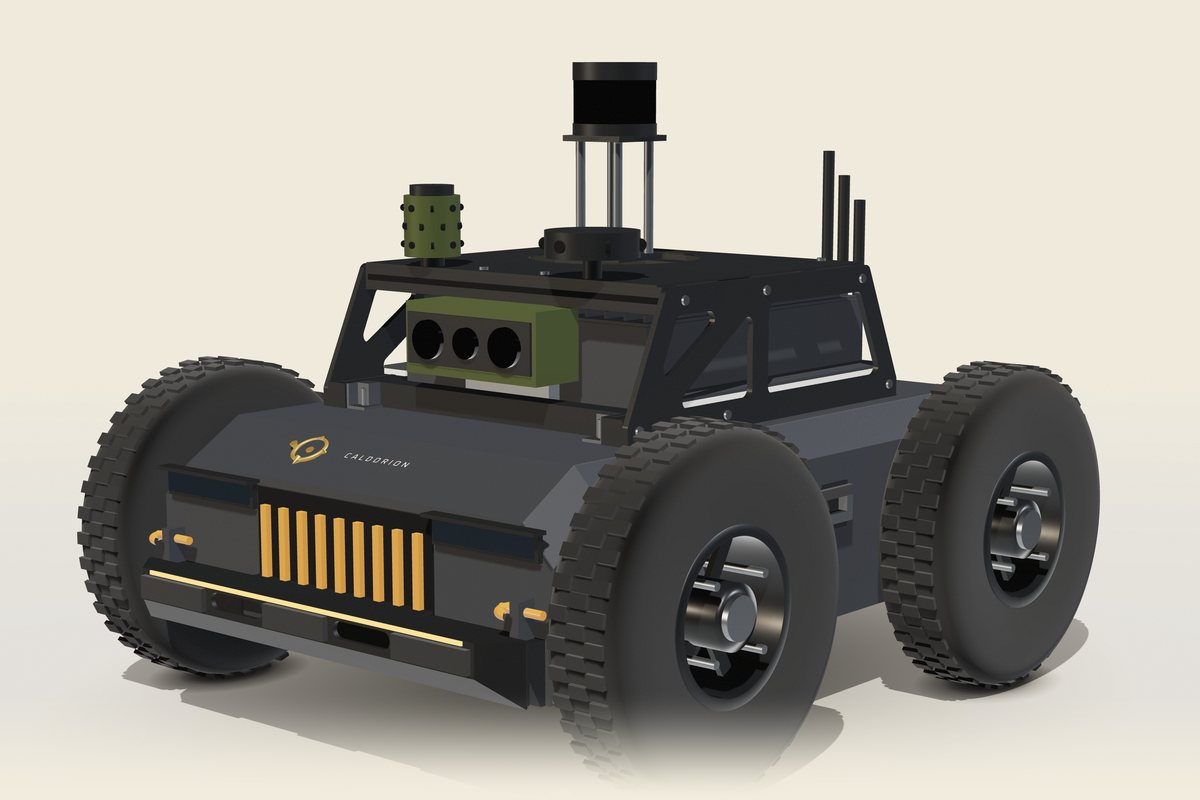
Caldorion's sensor payload integrates with an autonomous UGV or a fixed mast.
Processing is on board, so detection continues when links are jammed or lost.
Technology
Caldorion is a software company. We develop the AI algorithms and run them on commodity sensors and computers. The software is platform agnostic.
The payload and software run on any ROS 2 ground vehicle or on a fixed mast. Caldorion is also developing its own vehicle, the Argos UGV, built from off-the-shelf parts to control supply, cost, and NDAA compliance.
SIGMA reads every sensor as energy. It learns each site's normal pattern on its own, with no training set, and decides what to flag.
On-board AI on the UGV fuses LiDAR, cameras, GPS and inertial sensing, recognizes obstacles and terrain, and plans its own route indoors and outdoors, with no driver and no remote operator.
The agentic assistant reads the whole picture from every sensor and vehicle, explains each anomaly in plain language, answers the operator's questions, and proposes a response.
Analytics: SIGMA
SIGMA stands for Signals Intelligence Gathering, Mapping, and Anomaly Detection.
The features from every sensor are mapped onto the site's hex grid, one layer per sensor type. Each cell holds its own baseline, and SIGMA flags the cells where the site departs from it, while whoever caused the departure is still outside the fence. A flagged cell does not mean there is a threat. An operator reviews each flag and decides whether it needs a response.
Temperature and motion
Device activity
Air and soil signatures
3D structure and motion
Sound and vibration
Weather and air quality
Each sensor type is one layer on the site's hex grid.
SIGMA learns each site's own pattern of life on its own, with no training set, and grows more sensitive the better it knows a location.
Agreement across independent sensors produces the highest-confidence alerts, the hardest kind of threat to fake.
SIGMA alone decides what to flag. The Assistant explains those flags but does not make detection decisions, so every alert can be audited.
New sensor types integrate without re-engineering the core.
The caldor
The operator sees a live caldor heat map: cells are cool where activity is normal and hot where it departs from the baseline. The operator can focus on the hot cells instead of watching every raw sensor feed.
Peak deviation
Illustrative simulation
Autonomy
Perception, planning and control run on the vehicle's own computer, on ROS 2, designed to operate in a denied environment. A typical site runs multiple vehicles: one patrols while the others charge, so the site is covered around the clock.
LiDAR point cloud, cameras, GPS with RTK to centimeters, inertial sensing and wheel odometry.
Obstacles and terrain, ground it can drive on, its position on the site map, and moving objects.
Taught patrol routes and geofenced keep-out zones. It replans around obstacles and returns to charge.
Indoors and outdoors, with no driver and no remote operator.
Founders

CEO
M.Eng. Computer & Systems Engineering, Rensselaer Polytechnic Institute.
U.S. Marine Corps veteran (SIGINT).

CTO
Ph.D. Electrical Engineering, George Mason University.
Leads the SIGMA engine and signal processing.

Lead Robotics Engineer
M.S. Mechanical Engineering, University of Virginia.
Leads autonomous navigation on the UGV.
The name
kal-DOR-ee-on
The name describes what the company does: it hunts for threats in the energy a site emits.
Caldor (from Latin calor: heat, energy) + Orion (the hunter) = the energy hunter.
Standing
Registered in SAM.gov as CALDORION, INC. Unique Entity ID Y94MRL69JU45. SBA certification is in process.
The payload and software run on any ROS 2 ground vehicle or a fixed mast. Caldorion is developing its own, the Argos UGV, for supply, cost, and NDAA compliance.
Core detection methods; provisional filed March 2026 and assigned to Caldorion, Inc., non-provisional to follow.